This is a series of posts where I play 100 boardgames.
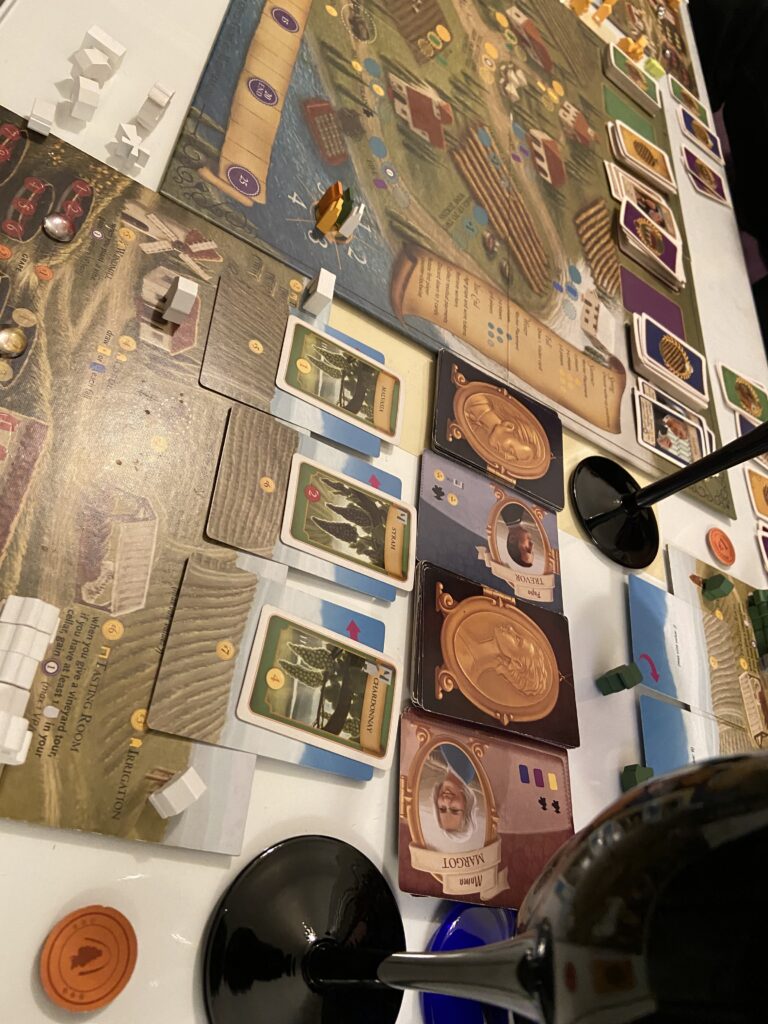
Game: Viticulture
Designer: Jamey Stegmaier & Alan Stone
Year: 2013
Country: U.S.A.
Publisher: Stonemaier Games
One of the traditional qualities of eurogames is that the theme and visuals have to be studiously mild. You can safely bring them out with elderly relatives you don’t know that well, because there simply isn’t anything a human being might have emotions about.
With Viticulture, U.S. designers have chosen to engage in a bit of cultural appropriation and replicate the characteristic eurogame style. Viticulture is an excellent game, but looking at the later games published by Stonemaier Games and you’ll notice that their themes tend to be significantly more colorful and unique.
But in truth, I have to confess that while I was playing Viticulture, the theme grew on me. The players each run a winery in Tuscany. The worker placement mechanics run through the whole process of winemaking, from acquiring potential varieties of grapes, to planting, harvesting, letting the wine acquire character in a barrel and finally bottling. Although there are various ways to get enough victory points to win, the most important one involves making wine and filling out orders.
I’ve visited wineries in Finland, France and Switzerland and have always found them quite lovely. Viticulture captures that same vibe with its thematic business simulator mechanics.
Playing the game for the first time, I was smart enough to know that in this genre of a game, you’ll want to get the force multipliers early. I recruited new workers which essentially gave me more actions. I built buildings which grant permanent game mechanical benefits. But I did not build the right buildings, as became apparent in the late game.
Typically I’ve found that if you want to win on your first time playing a new game, it pays to figure out the core loop and just hammer it repeatedly even if you don’t quite grasp how it leads to victory yet. That’s what I didn’t do this time, and the player who started fulfilling those orders for wine first won.
The worker placement mechanic is at the core of the game. When your turn comes around, you decide whether you put your workers to plant grapes or construct buildings. Amusingly you can also have them cater to tourists by showing the vineyards for an extra bit of cash. The basic loop was supplemented by visitor cards which you could play by assigning a worker into the appropriate space. My favorite was an unlicensed architect who allowed me to construct on the cheap at the cost of victory points.
Each full round of the game consists of one year, a wonderful thematic choice. The planting and harvesting of the grapes happens at different stages of the round, as is appropriate for a winemaking game which takes its theme seriously!