This is a series of posts where I play 100 boardgames.
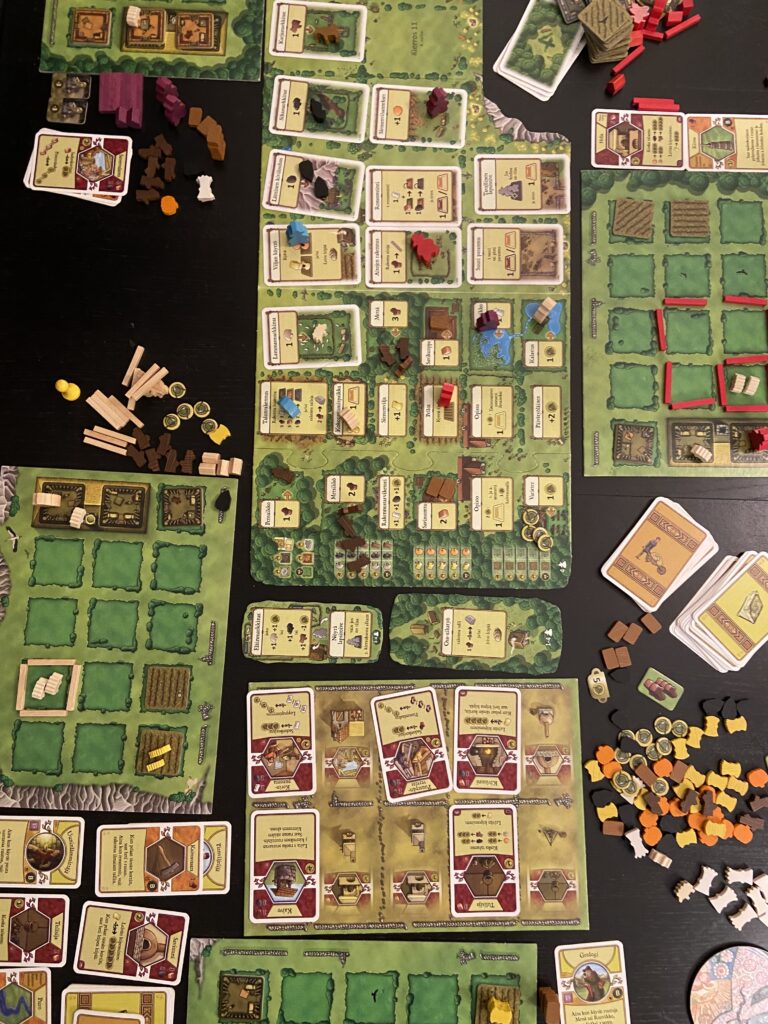
Game: Agricola (Revised Edition)
Designer: Uwe Rosenberg
Year: 2016
Country: Germany
Publisher: Lautapelit.fi
One of the criteria I have for choosing specific games is if they come up in discussions about boardgames as examples or benchmarks. Agricola is one such game. I’ve seen it referred to so often I felt I had to play it. It’s the archetypical worker placement game, about 17th century farmers desperately trying to eke a living from the soil.
Although Agricola’s theme is suitably earthy for a Eurogame classic, it proves to have surprising drama. It’s not a game where you accumulate giant amounts of victory points. Instead, you try desperately avoid penalties from begging for food or not having a turnip in your inventory at the end of the game.
The basic worker placement structure is simple: You place your workers at the different action spaces to gain resources, plant crops, renovate your mud hut or make small improvements to your farm. Ideally, you’d manage to leverage your livestock and fields into a self-sustaining engine which produces enough food to feed the whole family.
As an interesting touch, some of the action spaces are static and others are revealed semi-randomly after each round, so that as the game progresses more and more actions are available. Only one player’s worker can inhabit a single action space and as is typical of these games, someone else always uses up the action you needed. In our game, there was more cursing than at any game we’ve played during this project so far when we each in turn discovered that crucial resources or action spaces had become unavailable on the board.
Other topics of recurring conversation were the breeding mechanics of animals and humans and the Agricola-themed playlist I found which at one point had us listening to the mooing of cows from the Netherlands.
At first, harvest comes after three rounds, then two rounds, and finally after one round. If you don’t have enough food at this point, tough luck. For an abstracted Eurogame, Agricola’s theme is surprisingly tangible as the way the victory point economy is presented makes it feel as if hunger is always just a bad season away. I wondered at how much this effect was created by the presentation of the scoring system, because you could have kept the math pretty much the same but just eliminated negative modifiers and instead just made the whole thing reach into much higher numbers. Scores ranging from -5 to +5 feel different than scores from 0 to 10, but such a change would have made the game significantly less exciting.
Playing Agricola after Euphoria, Viticulture and Great Western Trail made it feel as if I’d gone back to the ur-text, the original from which other games are descended. Nevertheless, it was a surprisingly fast-paced and fun experience especially near the end when we’d learned all the many, many different actions.