This is a series of posts where I play 100 boardgames.
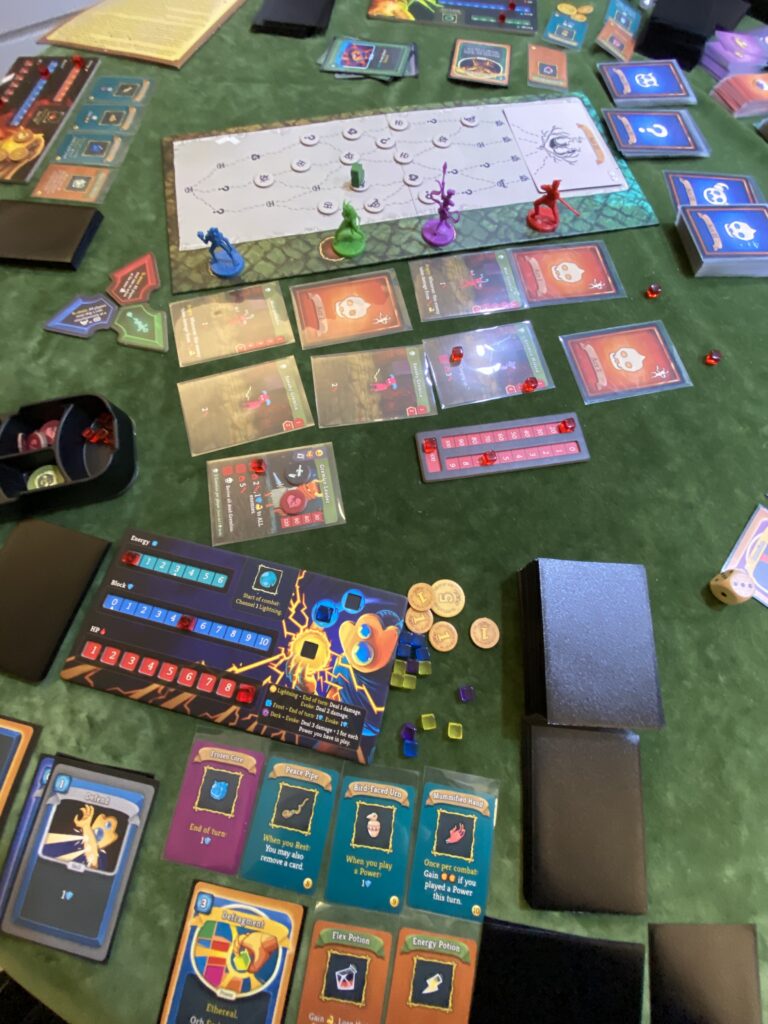
Game: Slay the Spire: The Board Game
Designer: Gary Dworetsky, Anthony Giovannetti & Casey Yano
Year: 2024
Country: U.S.A.
Publisher: Contention Games
Slay the Spire is a 2019 digital game, a roguelike deckbuilder in which you play a fantasy hero trying to ascent a tower, fighting enemies, upgrading cards and trying to survive to the next battle. The boardgame version is extremely faithful to the digital game, so faithful that you can discuss the changes at the level of individual mechanics and rules. Because the two versions are so easy to compare, it’s funny to note that while the digital game has purposefully lo-fi aesthetics, the production of the boardgame is high quality and glossy.
In Slay the Spire, you climb the tower in three acts, each time encountering a boss monster at the top. If you perform certain actions along the way (skip a camp, skip a merchant, fight a special miniboss), you gain access to the final, fourth act which consists of one last bossfight, even bigger than before.
The boardgame has been designed for up to four players, each playing a different character archetype. The characters function very differently, so learning how the four types of player decks work gives the game replayability.
It took us 11 hours to play through all the four acts and win the last battle. Despite this epic duration, the game stayed quite engaging and interesting. Although in a sense this is a dungeon crawler, in practice the design doesn’t have a lot of resemblance to the dungeon crawl boardgame genre. The card-based battles feel more like collective puzzles you solve together with the other players, performing actions concurrently, sometimes strategizing together to make sure events occur in the optimal order.
If any character dies at battle, it’s game over. This brought it’s own tension to the game, as after playing eight hours it would be painful to lose just because someone made a mistake fighting against a slime.
In addition to the battles, much of the challenge lies in the deckbuilding. You want to gain good new cards and get rid of weak starter cards. Along the way, you can finetune the focus of your deck according to your taste. My character type was the Defect, a magic user who was weak at the beginning of a fight but who built up power and capacity by channeling orbs and playing Power cards which remain in play for the duration of the battle.
For a first-time player like me, it was a good character type because while the possible actions gained in complexity, the basic playbook remained the same. The players of the other character types had much more thinking to do each turn, as they had to go through their cards to consider optimal strategy.