This is a series of posts where I play 100 boardgames.
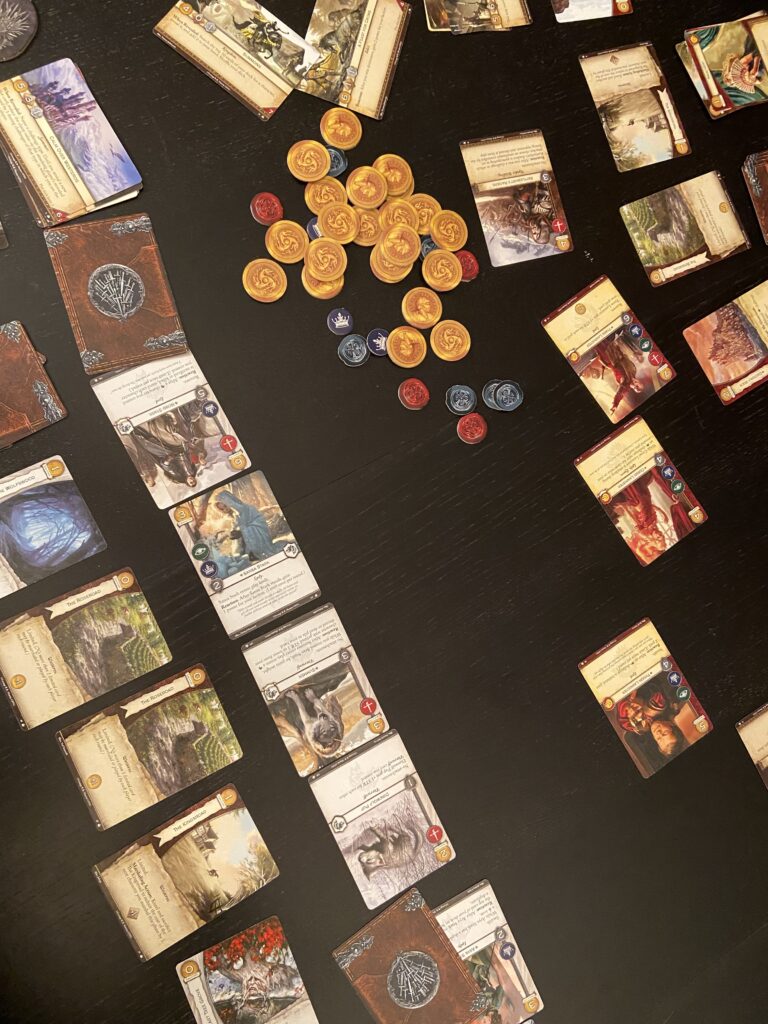
Game: A Game of Thrones – The Card Game (Second Edition)
Designer: Nate French & Eric M. Lang
Year: 2015
Country: U.S.A.
Publisher: Fantasy Flight Games
One of the goals I have for this project is to understand boardgames broadly enough so that when I go to a local game store, I know what I’m seeing on the shelves. For this purpose, I wanted to try out the Living Card Game format from Fantasy Flight Games, and already played Marvel Champions. A Game of Thrones: The Card Game (Second Edition) is the second game of this type I’m playing, and again it’s obvious that playing it once demonstrates how the game works but there’s a lot of additional depth provided by the various expansions and alternate decks.
A Game of Thrones: The Card Game (Second Edition) was easy and quick to learn. At the start, you choose which of the factions in the world you want to play. I played House Stark and my opponent House Lannister, the recommended factions for your first game. The faction has a corresponding deck and the base game comes with a good selection, including factions like the Night Watch and House Targaryen.
The first thing each player does during a round is to choose a Plot. The players have a selection of Plot cards each, and they influence the basic parameters of how the round is played, from hand limit to who goes first. Choosing the right Plot has to do with your tactical ambitions and goals for the coming round.
Players play three different types of cards from their hands to the table, characters, locations and attachments. Locations give small bonuses, such as +1 gold coin each round. Attachments bolster characters, or so I assume since I didn’t have any during my game. The characters are the primary tool players use for the next major phase of the round, the challenges.
There are three types of challenges, having to do with killing characters your opponent has played, forcing them to discard from their hand and taking victory points. Characters used to attack or defend for each challenge are tapped out, which means that they’re unavailable for other challenges. Each player can make each challenge once, so using your characters too early means you won’t have them in the later challenges. I made this mistake in our last round, wasting too many characters and thus having none to defend, letting my opponent gain a lot of victory points and win the game.
Interestingly, I found that being the first to attack was not necessarily for the best. Being first meant you had to commit resources without knowing how your opponent was going to commit theirs, which meant that you sometimes had more options if you came last.
The theme felt well executed at least on a grand strategic level. Of course, the titular “game of thrones” is all about this conflict between the various noble houses, so having that conflict modeled in the card game makes thematic sense.