This is a series of posts where I play 100 boardgames.
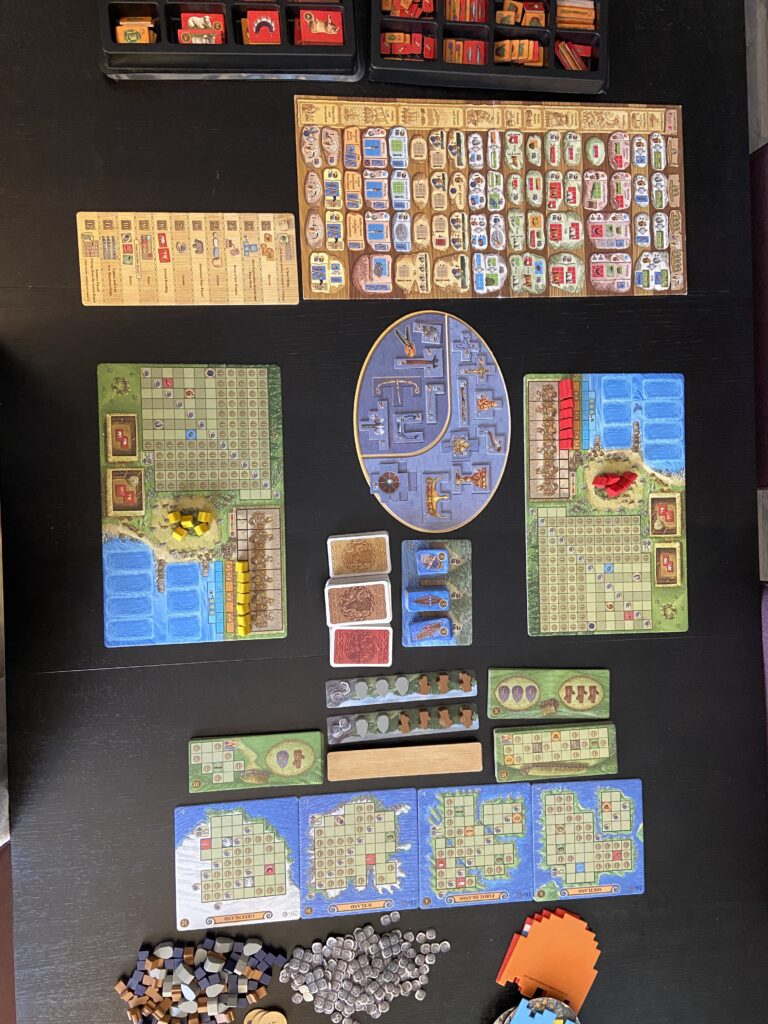
Game: A Feast for Odin
Designer: Uwe Rosenberg
Year: 2016
Country: Germany
Publisher: Feuerland Spiele
A Feast for Odin feels like a cathedral of work-placement design. It’s a game of huge scope and replayability simply because of the number of different tactics and pathways you can use to try to win. At first, the game feels forbidding because of the wealth of subsystems but once you get into it and grasp the iconography, it plays surprisingly smoothly.
The game is an attempt to simulate the various occupations of a viking settlement through worker placement mechanics. Right from the start, you’re provided with a ridiculously massive selection of different actions you can take, all collected together on one sideboard. Making sense of this terrifying stone tablet of game design was hard at the start and the message was clear: Once you grasp this, the gates of heaven stand open to you.
And it was so. The panoply of actions included trapping, hunting, raiding, trading, pillaging and plundering, going to mountains for resources and of course discovering new lands such as Greenland and Iceland. I made mistake in not focusing my strategy enough, and later tried to compensate by making whaling my main business.
One of the cool things in the game is that the sheer wealth of gameplay options makes the system feel like world of its own that you can explore. The story of your vikings is different than that of your co-players because it makes sense to try different things. There’s not a lot of player interaction but players can get in each other’s way on the action sideboard as an action that’s already occupied by someone’s worker vikings cannot be taken by someone else.
Each player board has a section which must be filled with various produce and loot like a slow-moving Tetris puzzle. As you accumulate various pieces, your income goes up and you cover more and more of the empty spaces which otherwise cause victory point loss. The risk in discovering new lands is that you get lots of points but also get an extra space you have to fill up with even more resources. I’m still unsure whether it was a good idea for me to explore or of it was a liability.
The titular feast is also a gameplay event, where every round you must provide enough foodstuff for your people to have a celebration. It’s a very similar mechanic as the regular consumption of food in Rosenberg’s Agricola, but the vibe is different. In Agricola, your starving peasants struggle to survive. Here, your hardy warriors feast with meat and fish.
Perhaps word feast features in the title because it also describes the feeling of looking at the gameplay options when you start. There are so many, but it’s also fun to sink your teeth into them.