This is a series of posts where I play 100 boardgames.
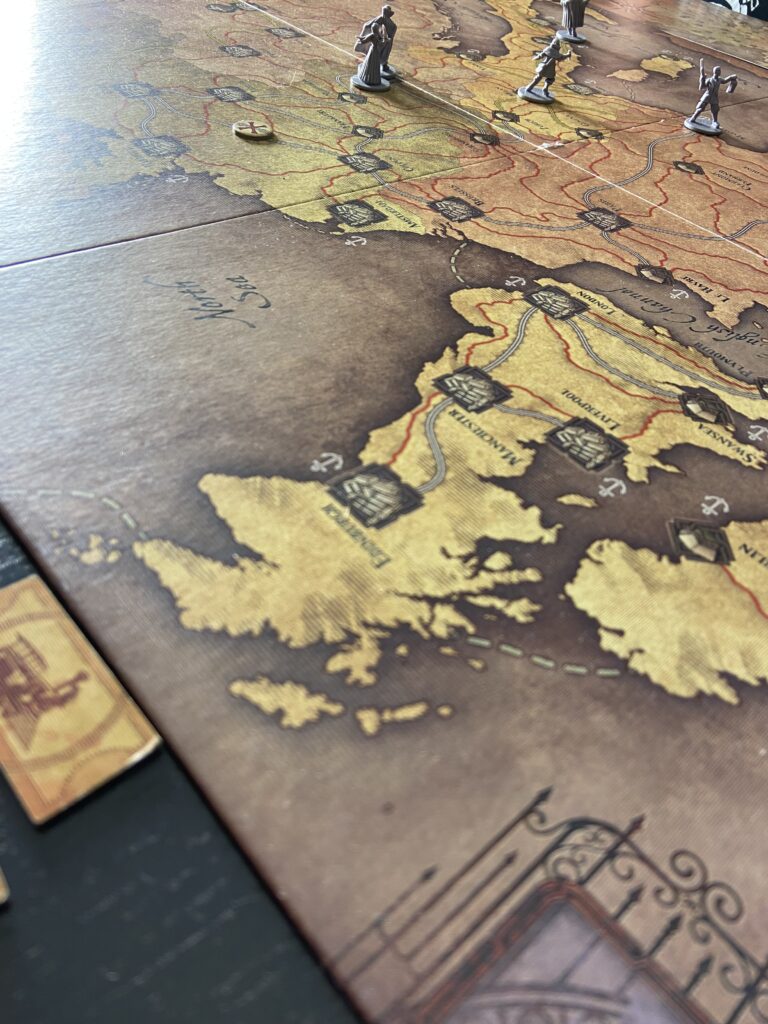
Game: Fury of Dracula (3rd Edition)
Designer: Frank Brooks, Stephen Hand & Kevin Wilson
Year: 2015
Country: U.K.
Publisher: Fantasy Flight Games
Set eight years after the events of the novel Dracula, Fury of Dracula has the Un-Dead monster rise once again and stalk the cities of Europe as familiar characters such as Van Helsing and Mina Harker try to stop him. The game’s most distinctive feature is its asymmetry, as one player takes on the role of Dracula and the rest play hunters working together.
One of the rules is that the hunter player need to discuss strategy openly in front of the Dracula player. In our game, this led to a lot of statements like: “I had an idea. I’ll tell you once Dracula has taken his turn.”
The game board is a map of Europe with cities connected by roads and railroads. Both the hunters and Dracula can also travel by sea, although Dracula takes damage is he does so.
Another distinctive design element is the hidden movement system. Dracula’s movements are tracked with cards played down on the board by the Dracula player. The cards show Dracula’s spoor. Hunters try to figure out where Dracula is and where he’s going by trying to chance on the cities marked on these cards. If I come to Prague, and Dracula has been there, the relevant card on the track is revealed and I know we’re on the right track. If I make a search, I can find unpleasant surprises Dracula has left in store for the hunters.
In our game, one player guessed Dracula’s location with amazing accuracy early in the game, but this didn’t seem to be as big of an advantage as we initially assumed. At first, Dracula had difficulty getting the Influence tracker to progress, and progress on that tracker eventually led to the victory of the Un-Dead in our game. Our hunters got close to Dracula a few times but he managed to slip to the sea, to another city, or otherwise evade our grasp.
The original Fury of Dracula was published by Games Workshop in 1987 and at times the design did feel more loose and archaic than is typical of modern games. We spent a few hours of playtime in a stalemate just running around the board with nobody gaining an advantage.
The best thing about the game is its atmosphere and the way the theme comes through. It feels like trying to hunt an elusive creature from city to city and country to country, just as it should be when following in the footsteps of a novel like Dracula.