This is a series of posts where I play 100 boardgames.
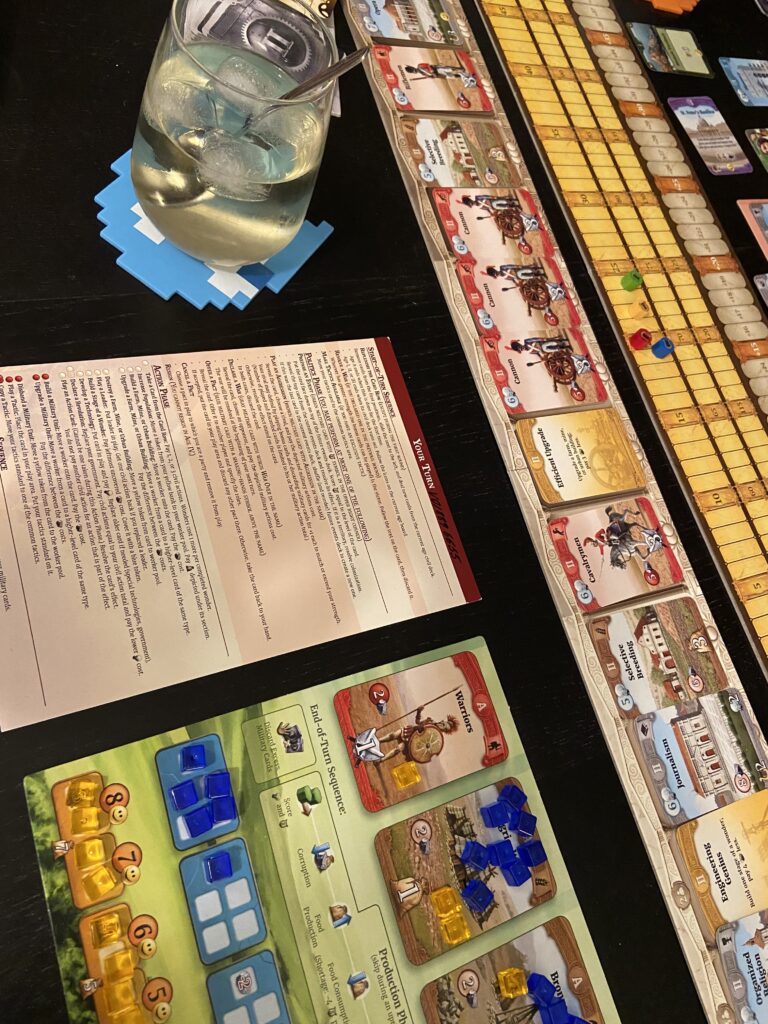
Game: Through the Ages: A New Story of Civilization
Designer: Vlaada Chvátil
Year: 2015
Country: Czechia
Publisher: Czech Games Edition
Among boardgame people, there’s broad consensus that Monopoly sucks. Why is this game so popular when better-designed games provide much improved experiences?
These complaints point to ideas about what’s considered good or bad design. What kind of an experience do we wish playing a boardgame to be? In the games that I’ve played recently, there have been a few shared assumptions:
- The game should be decided as close to the end as possible so that it remains interesting throughout.
- All players should have an enjoyable experience playing the game.
- The game should feel fair in that you feel like you had a chance and both positive and negative outcomes are equally distributed.
Some of these assumptions may seem obvious, but they’re not in the sense that you can also design for other outcomes and with other principles. Indeed, Monopoly’s original goal was political, to demonstrate the problem of capital accumulation. That’s most decidedly not the game goal as providing a fun experience for everybody.
This brings me to yesterday’s game, Through the Ages: A New Story of Civilization. It’s a complex civilization-building game which is so open about it’s creative affinity for the Sid Meier’s Civilization series of digital games that the designer Sid Meier is featured as one of the world leaders included. If you have played the digital games, you’ll recognize a lot in Through the Ages. Each player controls a civilization and seeks to guide it through time to become the most successful by accumulating the highest rating on the culture track.
There’s no central board. Instead, each player has their own mini-boards for their civilizations, and there are a few separate extra boards and tracks to follow everyone’s progress. The game is about resource allocation, making sure that your fields and mines produce enough that you can keep on building structures, wonders and military units.
Even the strategies for victory are the same as in Civilization: In our game, the winner won by focusing on scientific development early on.
The game is pretty involved, and it took us nine hours to play through antiquity, the major acts I, II and III and the short final act IV. One of us had played before and the rest were new to the game, meaning that considerable time was spent trying to understand the game’s multitude of systems.
As an experience, for me the game could be divided into three stages. The first was about learning enough to be able to play and the second about exploring the systems and having fun advancing my civilization. In the third and final stage, the other civilizations ganged up on me and stripped me for assets.
I was struck by how the game ended for me because it’s so rare to see this type of design in the games I play nowadays. While in many games the design attempts to keep all players involved through the experience, what Through the Ages did was the opposite: The military system creates incentives to attack the weakest, making them even weaker. Because attacking the weakest is mechanically advantageous to everyone, everyone does it, creating a loop where you’re slammed out of the game. As an experience, it sucked in a way that recalled playing Monopoly when I was a child.