This is a series of posts where I play 100 boardgames.
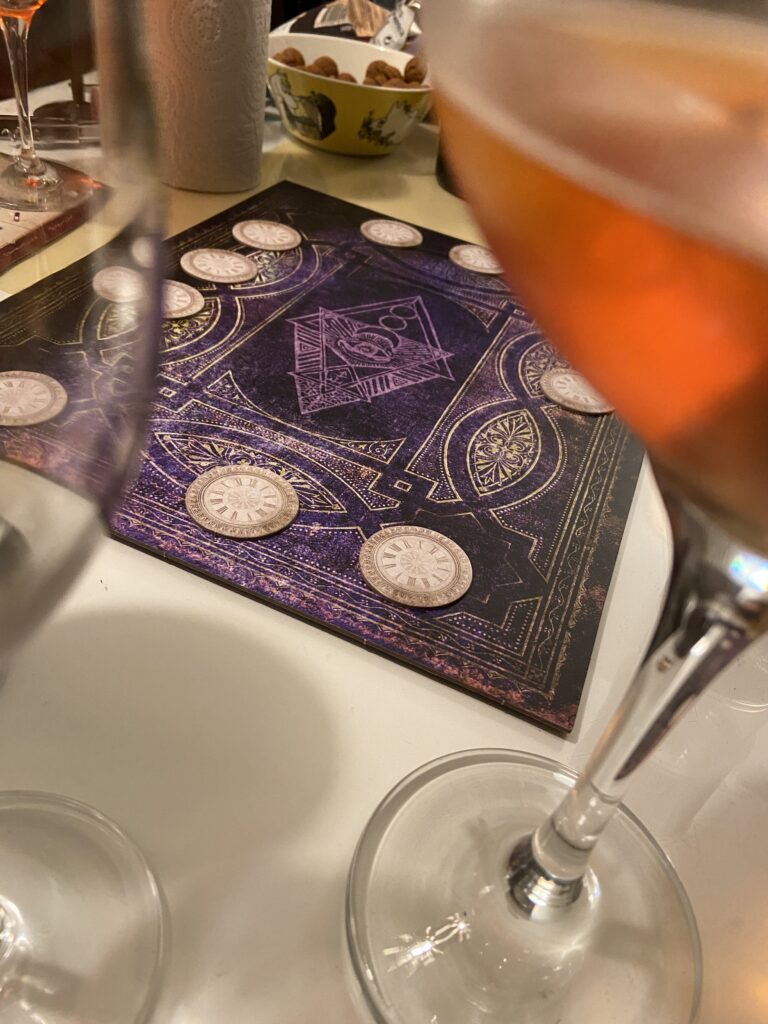
Game: Blood on the Clocktower
Designer: Steven Medway
Year: 2022
Country: Australia
Publisher: The Pandemonium Institute
At this point, In should mention that for the purposes of my study project, the definition of a boardgame is:
- A game played face to face, completely or largely without digital mediation,
- That’s not a roleplaying game.
I realize the usefulness of this definition is limited to my study project.
This brings us to Blood on the Clocktower. It’s a social deduction game, a sophisticated version of the folk game known variously as mafia or werewolf. In Blood on the Clocktower, a facilitator runs the game and the players are townsfolk, except some among them are secretly either the demon or its minions. Each day, the players talk among themselves and have a chance to nominate one of their own to be executed. Each night, the demon kills one of them.
Information control is crucial to the game. During the night, the players keep their eyes closed as the facilitator moves among them, tapping them if secret information needs to be conveyed. You don’t know what your co-players learn during the night.
In Blood on the Clocktower, the players have various roles, each with their own game mechanical effects. Pretty much all information is subjective, so if I say that my role is that of the Slayer, it might be true or I might be lying and secretly in service to the demon.
We played the game twice, and the two runs were extremely different. In the first, most players had not played before and experienced players dominated. Facts were established fairly quickly. In the second game, information was much harder to come by and everyone played much more confidently, making the dynamics of the game more complex and interesting.
In the first run, my character was that of the Scarlet Woman, a minion of the demon. We would have won if at the end of the game two characters remained, one of them the demon. My ability was that if the demon was killed, I’d have become the demon and the game would have continued.
In the second run, I was the Soldier, who’s immune to being killed by the demon during the night. I tried to play the lightning rod, masquerading as another type of character in hopes of getting the demon to waste effort trying to kill me. This was not particularly successful but it gave the game a lot of individualized nuance and strategy that each player had abilities like these.
In terms of physical presentation, the game is extravagant, with wonderful tokens, the grimoire/box used by the facilitator and reference sheets aplenty. While we played an introductory scenario, there are more, giving the game variety.
In addition to the ordinary townsfolk, there were also outsider characters who were not in thrall to the demon but who’s presence was decidedly a mixed blessing. One of these was the Drunk. The way it works is that any of the normal townspeople characters may secretly be the drunk and not know it themselves. They might think they’re the Undertaker, but in reality they’re drunk, and when they try to use their power, it produces useless results. This led to a lot of second guessing as players wondered if they themselves were the drunk, complicating the chains of logic players were putting together.