This is a series of posts where I play 100 boardgames.
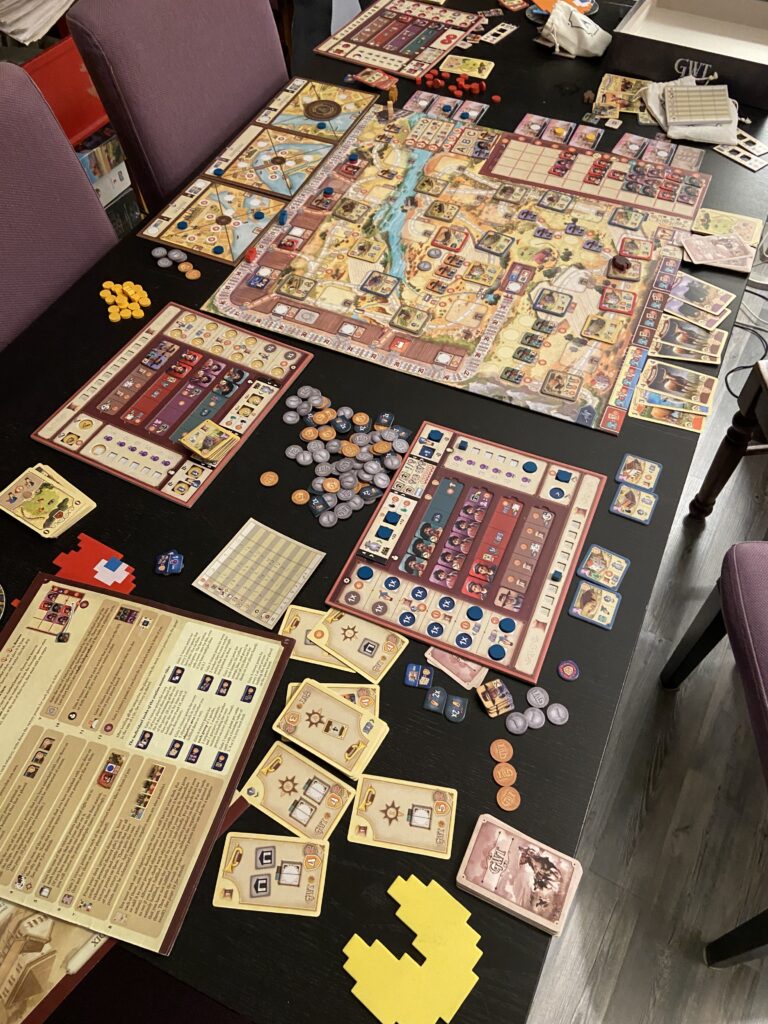
Game: Great Western Trail – Argentina
Designer: Alexander Pfister
Year: 2022
Country: Austria
Publisher: eggertspiele
We played Great Western Trail earlier during this project and I quite liked it. It’s a variation on worker placement where instead of placing the workers in static locations, you have a single worker who moves along the game board. In the story of the original game, you drive cattle in the U.S. and in Great Western Trail: Argentina, in Argentina. You have to get the cattle from the pampas to Buenos Aires where the meat and grain can be shipped to ports in Europe.
As your worker moves on the game board, you have a limited number of potential actions depending on where you are. Perhaps you want to move the train or place buildings. Like with Great Western Trail, the theme becomes wobbly if you think about it too much, but this time it bothered much less. Perhaps I’d gotten used to the idea that construction work is an essential part of cattle driving.
Although the core gameplay is the same as in Great Western Trail, some of the other aspects have changed. Instead of the Indigenous (and somewhat dated) characters, you now have farmers who can be recruited onto your player board. You don’t send cattle to train stations but instead load them onto ships, and once you have markers in ports like Rotterdam, you can gain the big bucks by selling grain. (And not meat. That’s just how the cattle business works.)
Another change to the formula is that the railroad runs from Buenos Aires to the depths of the country, in the opposite direction from player movement. As the trains move, they open up way stations which can be used to significantly shorten the trip and skip potentially difficult terrain close to the end. This is particularly important in the late game when players have access to many stations and want to complete cattle runs to gain as much money as possible to be able to afford those last victory-point granting buildings and cows.
Altogether, Argentina felt like a significantly more polished version of the same familiar experience. The South American setting was fun, different but instantly understandable.