This is a series of posts where I play 100 boardgames.
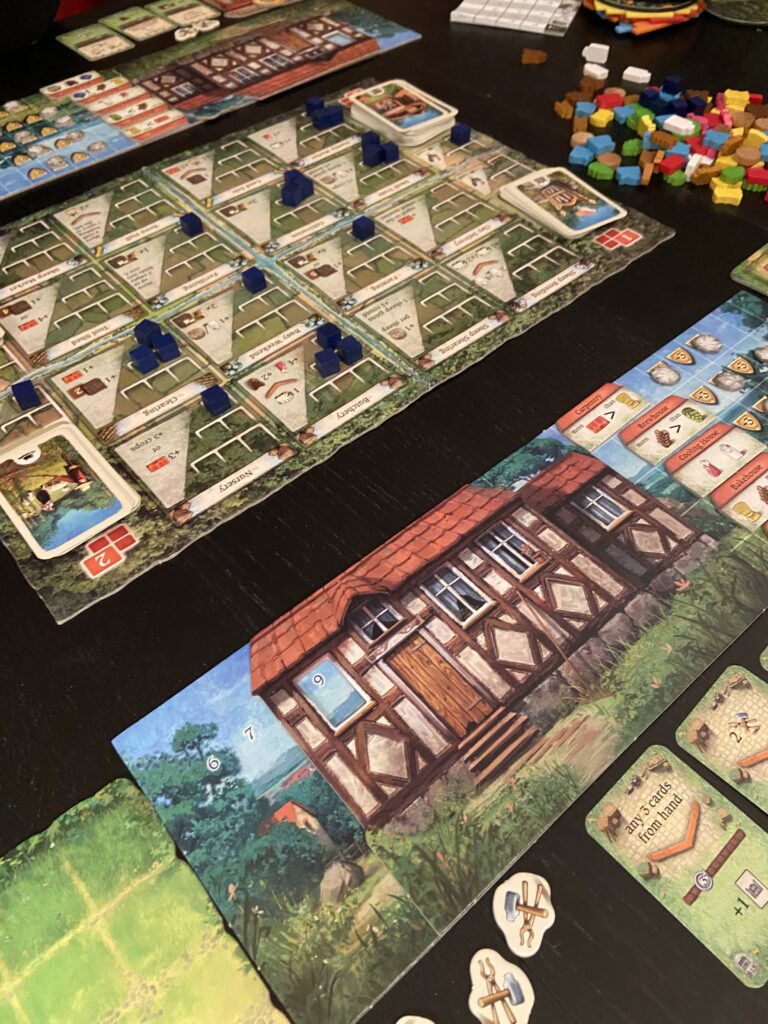
Game: Hallertau
Designer: Uwe Rosenberg
Year: 2020
Country: Germany
Publisher: Lookout Games
Hallertau is not the first worker placement game from Uwe Rosenberg that I’ve played. Agricola and A Feast for Odin came before it, making what would have otherwise been a pretty complex game reasonably easy to pick up. This despite the fact that the box proclaims this to be an “expert level” boardgame! Which it is, but usually packaging and presentation attempts to make all games seem approachable.
The basic concept is pretty familiar. You’re dealing with sheep, fields, different types of produce, and there’s a central board with different worker actions where you can place your cubes. The player who gets there first has access to cheaper actions.
There are six rounds of ten phases each, but only two of those are anything more complicated than upkeep. In phase four you assign the workers and in phase nine you move your civic buildings to the right so that your town hall can also move to your right on one of your many sideboards. This is difficult because moving your civic buildings costs a lot of wheat, meat, milk and other commodities, and the fields where they go to are full of rocks which also have to be moved.
I wasn’t sure about the game mechanical metaphor at this point, but I assume it has to do with upgrading and progress, as usual in these games. Spending increasing amounts of commodities to move the town hall proved to be essential for winning the game. As sometimes happens, I was slow to move it at first, then panicked, and spent the rest of the game moving it which proved to be a good strategy.
First you get a few starter grains, then you sow, then harvest. This happens on each player’s own sideboard where they have their fields, where fields move up and down in productivity depending on whether you use them or let them lie fallow. There’s also a different sideboard for the action cards which are used to track turn progression, and also to raise sheep. The sheep are always in danger of dying of old age (!!!), so you have to either somehow postpone their life or just slaughter them for more commodities.
The action board is divided into four quadrants and each action has three levels. The first to put a worker on an action needs one cube, the second two cubes and the third three cubes. In games with 1-3 players, the cubes are not all removed as a new round begins but instead, there’s a randomized mechanism which allows for different quadrants to be cleared and others to remain full. This means that the tactical landscape is a little different each time.