This is a series of posts where I play 100 boardgames.
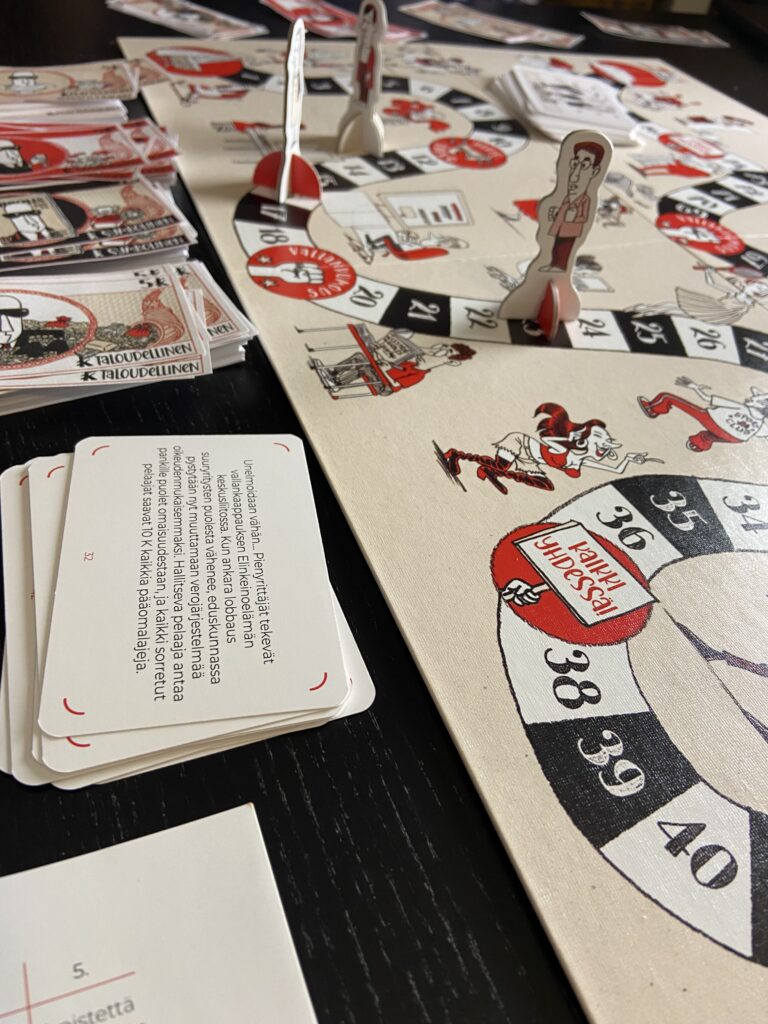
Game: Kapital!
Designer: Michel Pincon & Monique Pincon-Charlot
Year: 2019
Country: France
Publisher: Vastapaino
Kapital! is a French game about modern life in a capitalist society dominated by entrenched class interests. In terms of game design, it’s rudimentary, with a simple racing game structure and a deck of cards from which each player draws after they’ve moved down the track. These decks are where the game’s main substance lies.
The players are divided into two categories. One represents the 1% and the rest are the oppressed. The player representing the property-owning classes has their own deck of cards to draw from and five times as much wealth as the others at the beginning of the game.
The game has four types of wealth: Cultural, symbolic, financial, and social. The various card events cause you to gain or lose one or more of these types of wealth. Because the players of rich and poor characters draw from different decks, they naturally have very different events. A poor player works as a bicycle courier while a rich one takes their asset manager out to hunt.
Some of the cards posit a fictional scenario while others ask you to directly comment on your life. I had a card where if I lived in the most prestigious areas of my home town I’d gain money. Otherwise I’d lose money.
If the question had been formulated differently, I would have gained money because the very first apartment I and a few friends got when I moved away from my parents place was in Ullanlinna, which is pretty posh. It was a fluke of the rental market at the time, but it happened.
We played the game’s Finnish-language edition, which is more a localization than a translation. It felt surreal to play a game which directly and specifically referenced the actual political struggles that are going on right now. I haven’t experienced this with a boardgame before and it definitely made it hit close to home. Almost everything that came up from the decks was something I could have fired off an angry social media post about.
The game describes itself as a sociological take on the class struggle, and it has an analytical perspective, with many events contextualized with red explanatory text. To me, this came across as a bit superfluous, but this might be because with me the game was definitely preaching to the choir.
The most artistically ideal circumstances for playing this game would be at a family celebration where everybody was drunk and as many extreme political views as possible would be represented among the players. It would end up in a quarrel of massive proportions but I feel it would give the game a chance to shine. It’s made to provoke and it doesn’t quite fulfill it’s potential if everyone already agrees.