This is a series of posts where I play 100 boardgames.
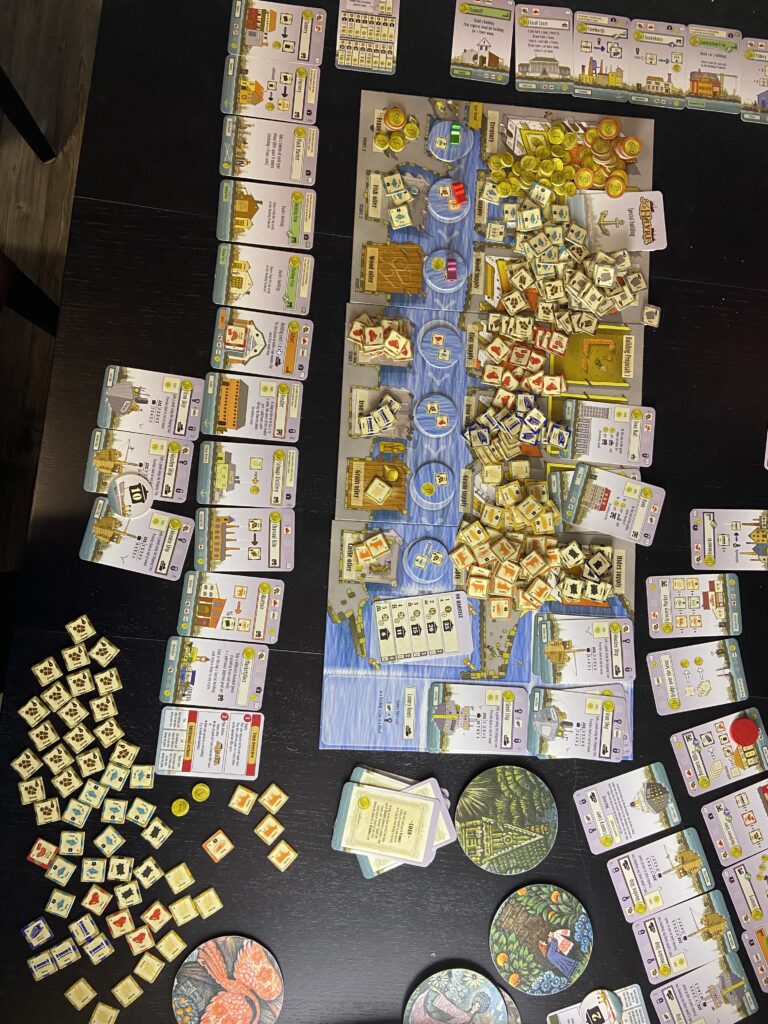
Game: Le Havre
Designer: Uwe Rosenberg
Year: 2008
Country: Germany
Publisher: Lookout Games
Le Havre’s designer is Uwe Rosenberg, who’s last game I played was Caverna and who’s probably most famous for Agricola. The ur-worker placement game, Agricola has a very specific vibe where you try to get production going while your family seems constantly to be on the edge of starvation. Caverna felt like a cheerier reskin of Agricola.
At first, Le Havre felt quite different. We’re in the French port city of Le Havre, trying to get our shipping business off the ground. We accumulate resources, buy buildings and ship off goods. At times, the game feels like a businesss simulator where the most valuable commodity is a player action.
However, once the game got going, shades of Agricola started to creep back… Surprisingly in a port themed game, most rounds end up in a harvest where your grain and livestock multiplies. Your people are constantly in danger of starvation, on a very steep curve, and you need to gather resources to keep them fed. Otherwise, you’ll risk incurring loans.
The constant struggle to keep enough food coming in meant that the emotional landscape of the game felt surprisingly similar to Agricola despite the different themes.
At times, Le Havre felt like a capitalism simulator. The player with the most money in the end wins. Most of the money is tied up in assets such as ships and buildings. Each building has a special function, and if an opponent built the building you need to use, you have to pay them for the privilege. Like in many other Rosenberg games, there’s a wide selection of possible actions. This time they’re divided among the players, with some held in common until someone decides to buy them.
Building ships is crucial if you want to succeed because they alleviate your food costs, provide victory points and make it possible for you to ship goods and make a lot of money. At times, Le Havre almost felt like a civilization game in the way it’s buildings and resources seemed to go through several different periods. In the beginning, you’re just picking up fish to feed your folks. In the middle, you’re desperately trying to build ships to stave off catastrophe. In the end, you have to have a good production pipeline generating enough of the game’s advanced resources to be able to build the best ships and buildings.
Despite its significant complexity, Le Havre’s basic player turn is nevertheless quite straightforward. First, you move your ship marker along the seven production tokens. The token indicates which resources are moved to the pools of available resources. (For example, one fish and one grain.)
Then, in the second part of the turn, the player makes an action. This may involve moving their single worker token into a building such as the Abbattoir, which converts cattle into beef and hides. Or it may be just to pick up all the accumulated goods of a single type from the board. In the late game, these piles can get pretty substantial as players focus on the building actions.
The complexity in the game comes from the economy of goods and building types, so that you have to follow chains of production to make sure you have everything you need.