This is a series of posts where I play 100 boardgames.
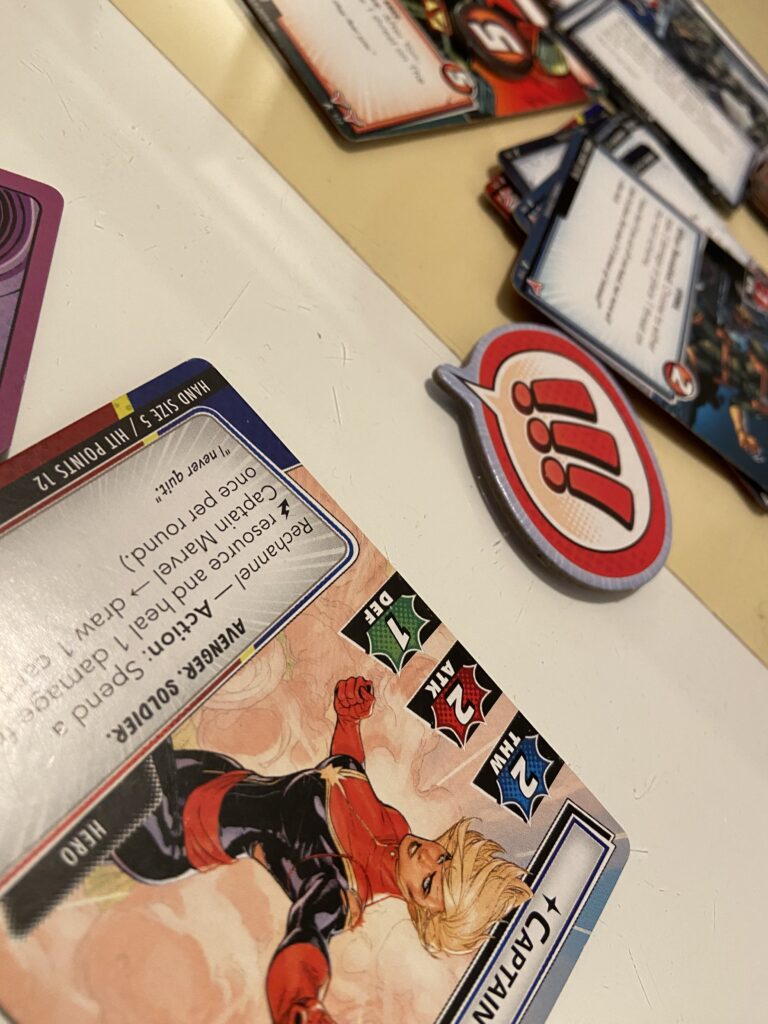
Game: Marvel Champions: The Card Game
Designer: Michael Boggs, Nate French & Caleb Grace
Year: 2019
Country: U.S.A.
Publisher: Fantasy Flight Games
Fantasy Flight Games has a format called Living Card Game, an expandable system where you have a core set introducing the gameplay and presenting initial options, with a range of supplements sold as separate products. Like in collectible card games, the precise body of cards you can use is in flux as new cards are introduced.
Obviously, the format makes a lot of sense from a sales perspective. If the players like the game, they can buy more expansions.
Marvel Champions is a cooperative Living Card Game in which each player controls a hero character trying to defeat a shared villain and stop their scheme. In the introductory scenario, we had Spider-Man and Captain Marvel fighting against Rhino who was breaking into a S.H.I.E.L.D. facility. In expansions, you get more heroes to play and more villains to fight, but the core set already has options including Iron Man and She-Hulk.
Each round is divided into the hero phase and the villain phase. During the hero phase, the players try to do one of three things, broadly speaking:
- Cause damage to the villain. This is how you eventually win, by beating the villain down.
- Thwart the villain’s scheme. Each round, the villain adds token to the scheme card, and if there are enough, the villain wins and the players lose. Thwarting the villain means the hero removes tokens from the scheme card.
- Build up the hero by adding allies, locations, superpowers and upgrades.
The first time we played, we lost because we focused too much on simply damaging the villain. The second time, we won because we took our time building up our heroes and then unleashing more powerful abilities.
During the villain phase, tokens are added to the scheme, the villain attacks the heroes and the players have to draw encounter cards in which something bad always happens. One of the fun complications of the game is that each hero has a secret identity. They can flip between the alias and their hero persona, and if they’re in their secret identity when the villain starts their turn, they won’t get attacked. Instead, the villain furthers the scheme. I played Captain Marvel and flipping between the civilian and hero identities was crucial for healing the character and keeping them in the action.
There are several possible complications in the villain phase. The villain may gain minions, lesser villains who also attack the heroes. They may add additional schemes which must be resolved before the main scheme can be thwarted. The heroes have personal enemies who may come into play with their own schemes, and even civilian problems such as Spider-Man’s trouble with getting evicted.
The game successfully evoked the experience of a superhero fight which escalates as new characters enter the fray and an alien arch enemy with a mysterious device might show up at any time.