This is a series of posts where I play 100 boardgames.
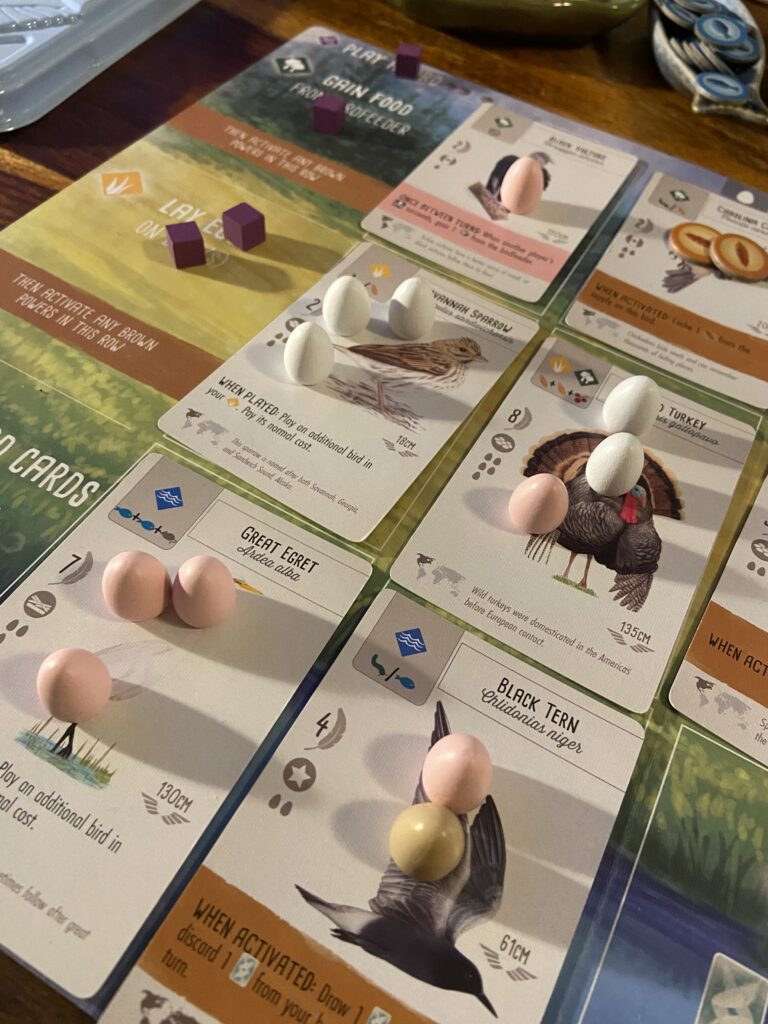
Game: Wingspan
Designer: Elizabeth Hargrave
Year: 2019
Country: U.S.A.
Publisher: Stonemaier Games
In the last five years or so, it has felt like everyone I know is playing Wingspan, so it was high time for me to play it as well. It’s a fairly approachable, intuitive mid-complexity engine building game in which you try to place birds into the appropriate habitats to gain important resources so you can place more birds into their habitats.
There are three habitats: forest, grasslands, and wetlands. Each habitat is also a track for acquiring a crucial resource. Taking a forest action gives you food, grasslands give eggs and wetlands more bird cards. As you place birds into each track, they develop, granting more of the resource. The engine building comes in with the activations, as each time you take a forest action, for example, you may also choose to activate appropriate abilities from any suitable birds you’ve played there previously. If you play your birds right, one forest action escalated into a number of cumulative activations. The board is designed so that you can convert resources to some degree, so if you have a beast of an egg engine, those eggs can eventually become other resources too.
In terms of presentation, Wingspan is a wonderful game. The birds are all actual animals, complete with their Latin names, matched to appropriate real-life habitats. Thus, you can pretend you’re learning something as you hone your resource-production engine. A co-player said that mixing core sets and expansions from different languages is a mistake because trying to figure the birds out simultaneously in multiple languages is hard and certain game mechanical dependencies break down. For example, some cards play on commonalities in the names of different birds, which doesn’t work if those names are completely different in another language.
The game comes with a wonderful birdfeeder dice tower which adds a playful element into the act of picking up food resources. Dice tumble from the feeder and each die result indicates a specific food type. Those food resources are then available for anyone willing to use a forest action.
The very first thing I tried to do in Wingspan was to play a bird onto the forest track. Then I noticed it had an ability which would allow me to pay another bird immediately afterwards if I had the resources to pay for it, so I went to get the food before playing any birds. Then I learned about the eggs, and had to take a grasslands action to get some. But I couldn’t do that without a bird to place those eggs onto. So then I took a completely different bird, played it, and after a long series of moves finally managed to play that first card I’d started with.