This is a series of posts where I play 100 boardgames.
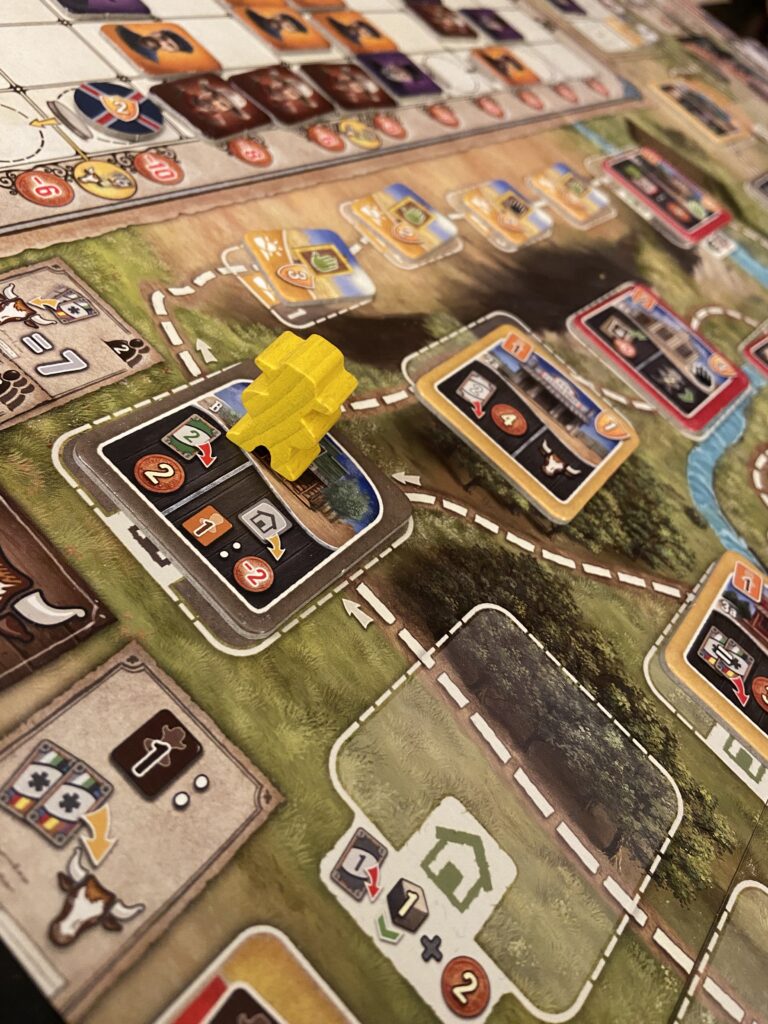
Game: Great Western Trail
Designer: Alexander Pfister
Year: 2016
Country: Austria
Publisher: eggertspiele
I’ve played several worker placement games, but in the phrase of a “how to play” video I watched, Great Western Trail is a worker movement game. The players are ranchers in the Wild West, driving cattle from Texas to Kansas City to be sold. Through the game, you move your cattleman from location to location along the trails on the board, completing runs and making money. The locations you land in determine the available actions each turn.
There are a couple of cool ideas in Great Western Trail I haven’t seen before. One is the way the actions depend on where you are on the board, making you try to land in the right locations in the right order while still making haste. The tactical decisions and plans you can make are rich and interesting, while the turns still keep moving pretty quickly because each round you only have a few actions to make.
Another interesting idea is that when you create a new building on the trail, it also adds a new stop. At the start, the board is half empty and the cattleman moves quickly because you don’t count empty locations for the purposes of movement. When those locations are built, they became relevant for movement and offer new actions. This way, the board becomes more complex as the game progresses.
This also points to another interesting characteristic of Great Western Trail. I’ve rarely played a game where the discrepancy between the quality of the mechanics and the implementation of the theme were in such contrast. Purely as a game mechanical design, Great Western Trail is excellent. It’s a complex eurogame in which there are always multiple strategies, meaningful actions, and good tactical choices. After we finished our game, I immediately felt like I wanted to play it again.
The Western theme, on the other hand, falls apart the moment you focus on any particular aspect. The ludonarrative dissonance, as we say, felt almost shocking after playing such painstakingly harmonious games such as War of the Ring: Second Edition.
So yes, obviously while you drive cattle from Texas to Kansas City you build various structures. You naturally sell your cattle multiple times in the hopes of getting better cattle from the game’s deckbuilding subsystem. Once in Kansas City, you send your cattle by train to the furthest possible city, the best destination being San Francisco. To help with this, you move your train along the track using a separate action, and if you would hit the train of another player, you leapfrog it, as trains naturally do.
It makes sense as long as you look at it cursorily, but the more you engage with it, the less sense it makes. The theme and narrative of the game don’t help with understanding and internalizing the mechanics because they pull in different directions.
Yet despite this thematic chaos, Great Western Trail is a genuinely original combination of deckbuilding, worker placement and even a racing game. Once you grasp how it works, you discover the simplicity hidden inside the complexity. The choice of location for your cattleman streamlines the game, funneling you to specific actions.