This is a series of posts where I play 100 boardgames.
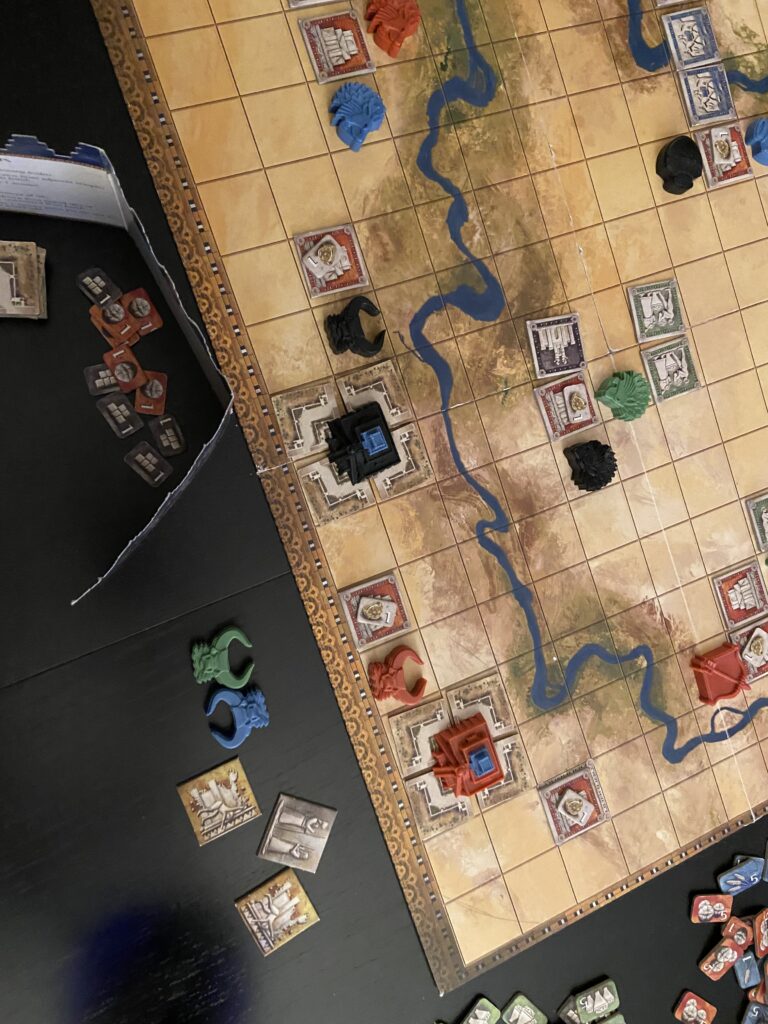
Game: Tigris & Euphrates
Designer: Reiner Knizia
Year: 1997
Country: Germany
Publisher: Hans im Glück
Before we’d played Tigris & Euphrates, a friend told me that it was a bit like chess in that you only grasp the possibility space and understand what can be done with it once you’ve played it. Maybe a few times. That turned out to be correct.
The rules of the game are not that complicated but the tactical options they open up are highly varied. Playing it for the first time, it felt like every time I did something, I suddenly understood the vast implications it would have on the board. At the same time, I found Tigris & Euphrates oddly difficult to grasp, perhaps because patterns of thought from other games were so useless here.
Tigris & Euphrates is a tile-laying game where you lay down tiles from four different colors onto a board representing ancient Mesopotamia. Although there is a theme in that the game is about the rise and fall of ancient civilizations, it remains pretty abstract. The important thing is to put down those tiles and get the victory points from each. In an interesting twist, you collect four types of victory points, one for each color, and at the end you only use your lowest score.
This means that if my points are:
Red 23
Black 21
Blue 11
Green 3
then in the final scoring, I’ll have three points. This encourages trying to build in a balanced fashion. It also means that as the game nears its end, you realize that most of the points you’ve accrued are useless and you need to focus on the lowest one by any means necessary.
The red tiles are temples. There are a few on the board at the start, and each player has four leaders, one of each color. You only get victory points for laying down tiles that are connected to your leader of the same color, so laying down a red tile adjacent to your red leader means you get a point. If you instead lay down the red tile so its connected to an enemy players’ red leader, they get the victory point.
This way, you grow little kingdoms around your leaders and gain points. Interestingly, you can reassign your leaders to new positions and even try to attack or subvert the tile formations of other players. Players can also build monuments which generate victory points each round and gaining or blocking access to these is one of the reasons to wage war.
One of the reflexes I had which impeded play was that I felt like I was building my own little realm and needed to defend it. This was not strictly speaking true. For example, if an enemy player managed to build a good monument system for generating green victory points, I might want to move my green leader there, incite a revolt and benefit from their hard work. Or two players might have leaders of different colors co-existing in the same kingdom without issue.
In the subsystems for revolt and war, players count tiles of different types and play more from their hands if needed. The mechanisms were quick and brutal, and the risk of losing when attacking someone was high.
I’m confident that the next time I play this, my tactics would be totally different now that I’ve better grasped how the game actually works.