This is a series of posts where I play 100 boardgames.
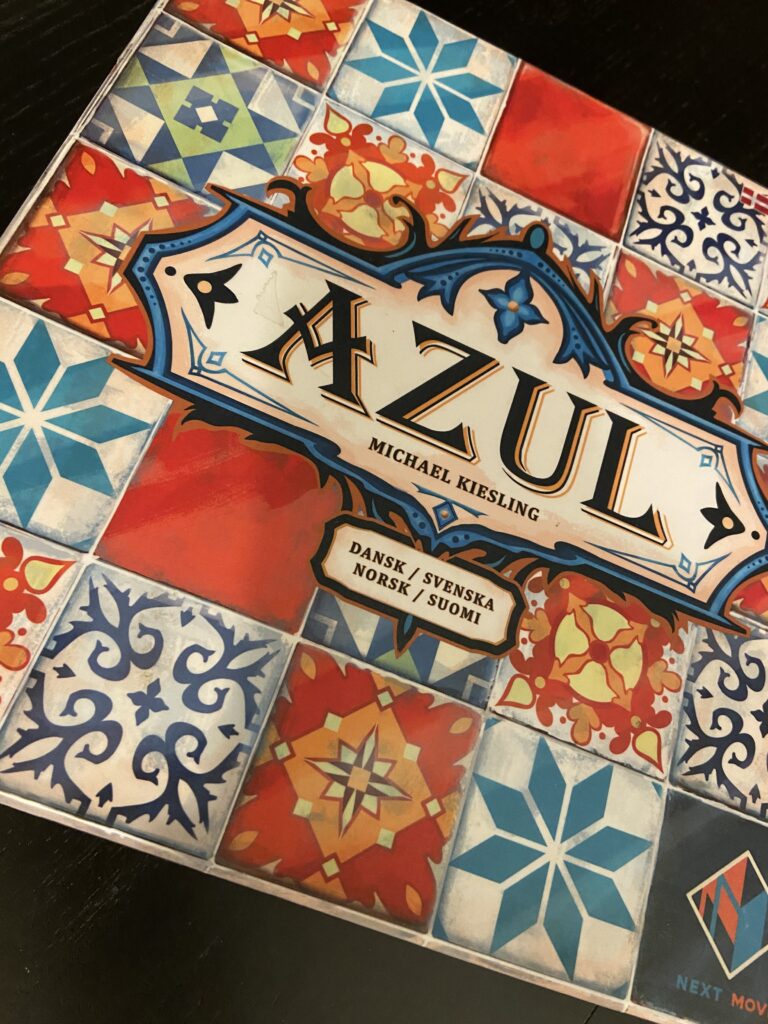
Game: Azul
Designer: Michael Kiesling
Year: 2017
Country: Germany
Publisher: Next Move Games
As a result of my project to play 100 new boardgames, I wondered about what it meant for a boardgame to be beautiful. What is beauty in this context? I asked about games people thought were beautiful on Bluesky and Azul is one that came up. And for a reason! It is beautiful, both in terms of visual aesthetics and the elegant simplicity of its design.
Inspired by Moorish decorative tiles, Azul is a simple and elegant game in which each player picks up tiles from amongst the offerings of different manufacturers and tries to match the pattern while gaining the maximum number of points from adjacency and other bonuses. It’s very simplicity made me think that this must the hardest type of game to design because there’s no forgiveness for error or clumsiness. You can disguise weaknesses among the moving parts of a big, complex game, but in something this simple, you have to get it right.
At first, playing Azul felt like a shared single player experience where my attention was focused on my own player board and I wasn’t really looking at what my opponent was doing. I was trying to pick the tiles I needed with as much economy as possible. Each manufacturer’s offerings are presented on a little round disc which holds four tiles. You pick all tiles of a single pattern, and the remaining ones are cast to the middle.
You can also pick tiles from the middle, but then too you have to take all that have the same pattern.
After losing my first game, I started to better grasp the interplay between my and my opponent’s choices. I realized I could see which tiles they most needed and block their strategy, or just figure out how to avoid being blocked myself. I learned to pick the last tiles from the board strategically to benefit myself and cause problems for my opponent.
Visually, Azul is very pleasing. Some of the tiles are individually beautiful, and the patterns formed during play are lovely to contemplate. Simply handling them feels aesthetically meaningful. They’re picked out of a cloth bag and placed on patterned discs as offerings from the manufacturers, a process that also has a tactile quality to it. It points to the question of why the game feels enjoyable to play. The mechanics play a part, but there’s also a more nebulous pleasure to it of being part of a world of patterns and simple, beautiful objects.
There’s a story about carpet weavers who intentionally make a flaw in the pattern because only God is perfect. In Azul, when the starting player picks up their first tiles, they put the first player token in the middle. Whoever is the first to pick up tiles from the center also has to take the first player token. At the bottom of each player’s boards is a runoff track. Each tile placed there confers a penalty to the score, and that’s where the first player token goes when picked. You lose points if you can’t use your tiles just so, but then again, the very choice and freedom in games invites imperfections and dead ends. The flaw is part of the beauty.
One thought on “100 Boardgames: Azul (29/100)”
Comments are closed.