This is a series of posts where I play 100 boardgames.
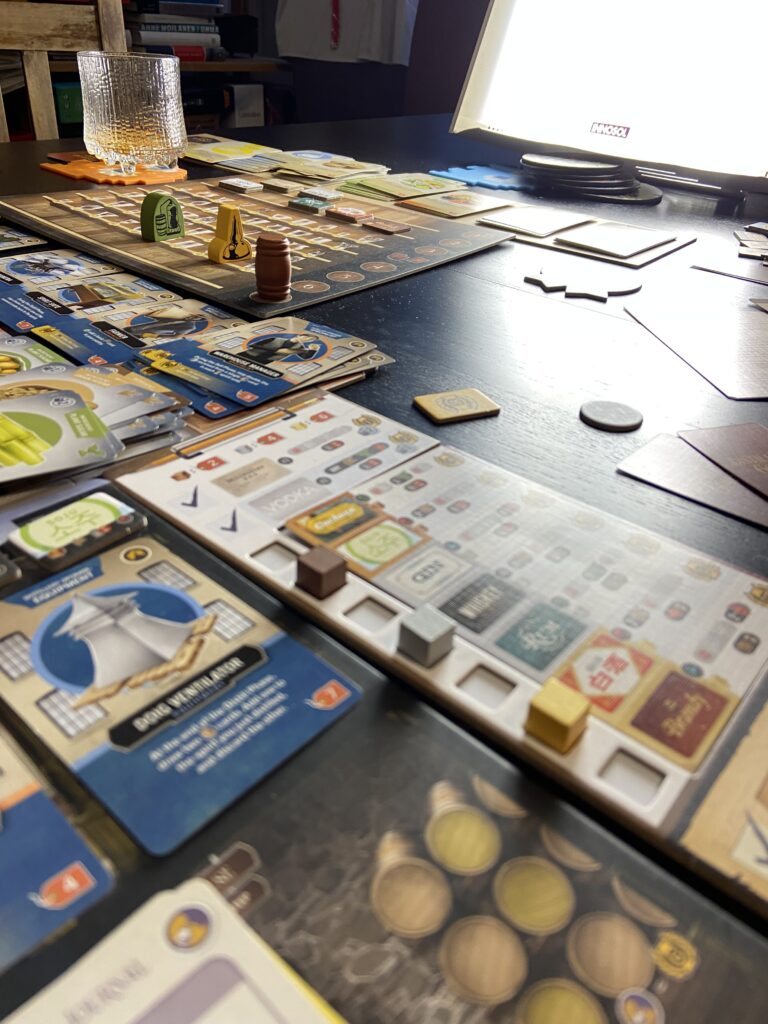
Game: Distilled
Designer: Dave Beck
Year: 2023
Country: U.S.A.
Publisher: Paverson Games
A game mechanic must function as part of the game’s overall system. It must be enjoyable and contribute to the play experience. It must connect to the theme and make sense within the game’s broader creative framework.
Distilled is a game about distilling spirits in which each player has a distillery somewhere in the world, and they compete in trying to create and sell the strongest and most flavorful spirits. It has a distilling mechanism where you assemble your ingredient cards such as yeast, water, and mixed grains, until you have a stack of varying size. In the early game, it’ll be modest and in the late game it’ll be a solid pile of cards. You shuffle the stack and take out the top and bottom cards. This adds an element of randomness into the distilling process.
As a result, you have a spirit, represented by the stack. You add a label suck as Vodka. If you have the right upgrades or age your spirit over multiple turns, the card stack accrues flavor cards which further increase it’s value.
Of course, you need a barrel card and a bottle card too before your spirit can be taken to the market. They too add to the characteristics of your spirit.
This process is wonderfully evocative in terms of the theme of the game. It feels like I’m putting together something new and slightly unpredictable when I assemble my card stack. If I leave it in the warehouse and sell it only close to the end of the game, I’ll have a real depth charge of victory points to suddenly unleash.
In terms of theme, Distilled reminds me on Viticulture, but it’s not a worker placement game as much as it’s about collecting cards into functional stacks (i.e. the spirits). The interaction between players is very limited, mostly about who gets to pick up an interesting ingredient, upgrade or item from the premium market first.
At the start of the game, each player picks a character which imbues them with a special ability and a signature spirit. Making the signature spirit grants a lot of points but requires the use of specific ingredients harder to put together than the average bottle of whisky.
On the table, you’ll have common ingredient cards such as water and yeast, of which you can pick two in the market phase of one of the game’s seven rounds. After you make money selling spirits, you can buy some of the more expensive premium ingredients from a separate, premium market with its own changing selection. Keeping an eye on the offerings of the premium market is important in terms of adapting your tactics to what’s possible.
The strength of Distilled is in its emotional and thematic design and how the game mechanics support the feeling of growth and discovery. Although it is competitive, it felt like a very positive game in that each batch of spirits distilled and sold was its own minor accomplishment.