This is a series of posts where I play 100 boardgames.
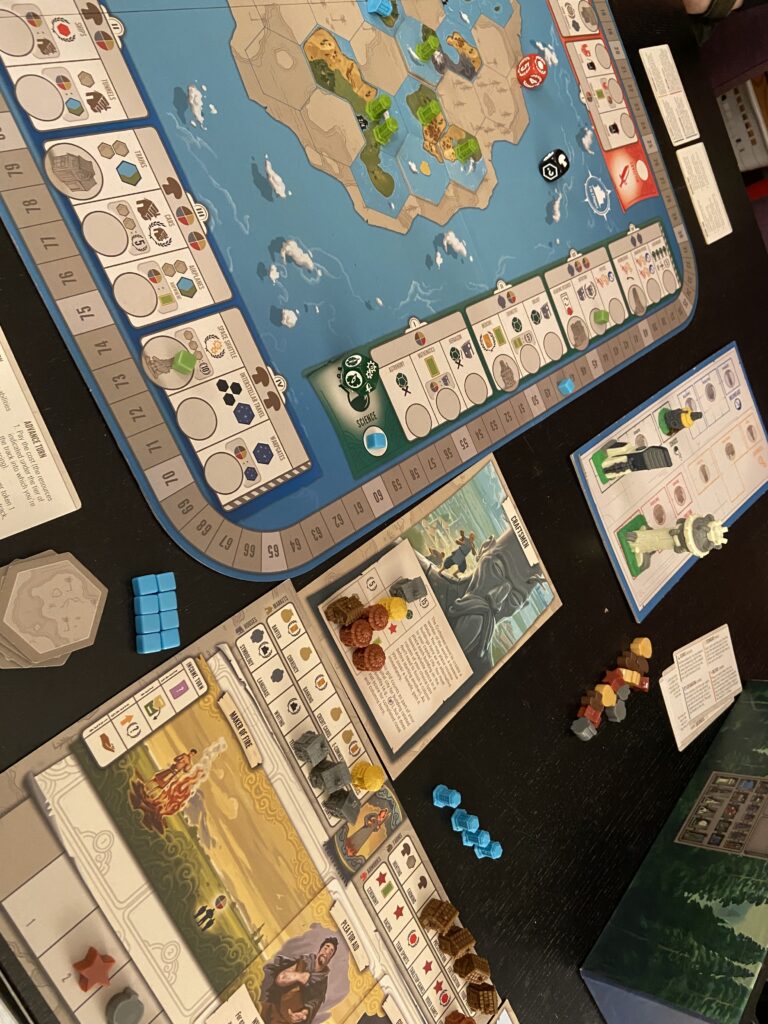
Game: Tapestry
Designer: Jamey Stegmaier
Year: 2019
Country: U.S.A.
Publisher: Stonemaier Games
Civilization games are an interesting genre in that the main touchstone is not a boardgame at all, but the venerable videogame series Civilization. It lays out the assumptions about how these games are going to work: Exploration, empire building and scientific progress are all going to be important. The goal is to simulate the totality of human history as a grand sweeping tableaux.
Tapestry is more friendly and easier to learn than many games in this genre, based on a simple, easy to learn and quick turn order complicated by all the variety and detail of the individual actions you can take. They depend largely on how you progress along various tracks such as Science and Exploration, each new level presenting you with a new type of action or a mechanic that helps your civilization to grow.
A high level of abstraction means that the game proceeds at a pleasant pace despite its all-encompassing topic. The scientific advances don’t gatekeep other game elements, instead just contributing to unlocking new resources and collecting victory points the same as many other aspects of the game as well.
The fact that progress on the different tracks determines what actions you can take means that every round, your choices are a little different. Normally, you can only do the action of a single new track level once, even if the later ones are similar in nature.
As a boardgame, one element above all shapes the perception of Tapestry: It has cool little three dimensional buildings that are fun to look at. If you’re the first to make it to a particular level on a progress track, you get a special building to place in your capital, such as the Tank Factory. The capital minimap is a subsystem where you try to place buildings so that they form lines or columns, granting you points. The landmark buildings unlocked from the tracks take up a lot of space so they’re very useful in maximizing the victory point yield of your city.
More than that, they’re satisfying physical objects instantly elevating this game above its peers.
The name of the game refers to a mechanic where you get tapestry cards which are played when you ascend to a new era. They’re the progress marker for your game, and you place them on your personal income board. As you use the three tapestry cards you can play during your game, you form a rough story of what your civilization did. It gestures towards telling a broad story of history, but the details are extremely vague as in the end it’s just three cards with suggestive titles.
In our game, the choice of civilizations had a huge impact on the shape of play. My co-player had a civilization which instantly advanced him on all the tracks, granting immediate access to the more advanced options but also leaving me to run rampant over all the low-level actions. This suggested that the different options for civilizations and other randomizing aspects of the game give it a lot of replay value.