This is a series of posts where I play 100 boardgames.
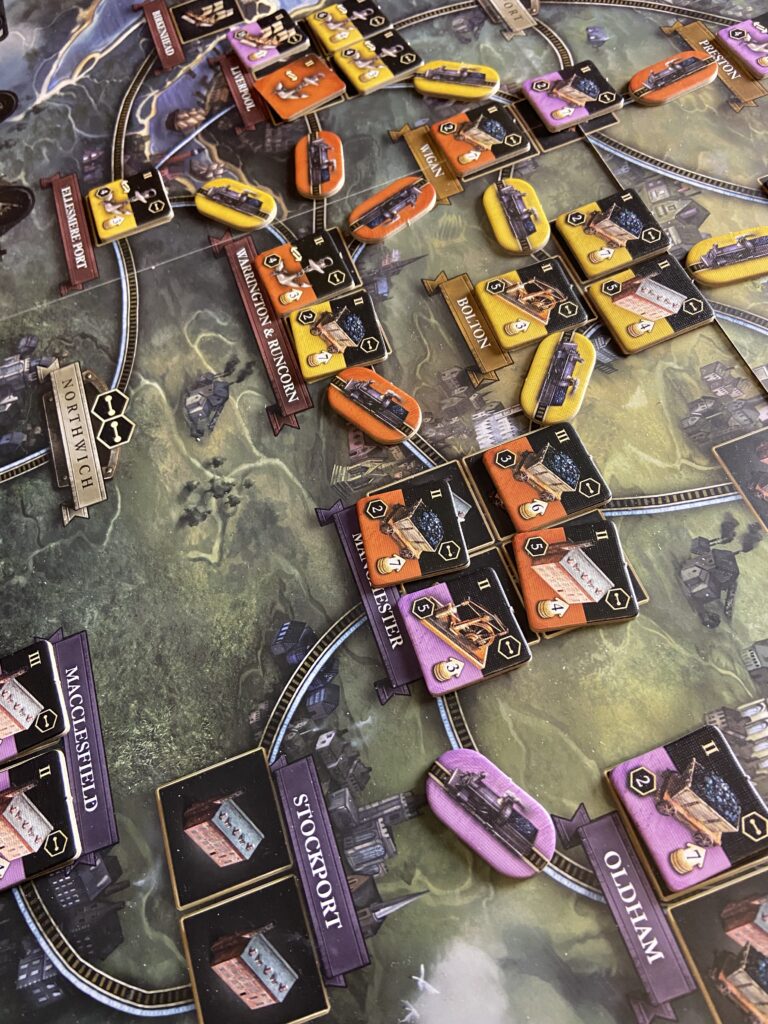
Game: Brass: Lancashire
Designer: Martin Wallace
Year: 2007
Country: U.K.
Publisher: Roxley
I played Brass: Birmingham and Brass: Lancashire backwards in the sense that I started with Birmingham and played Lancashire only now. Brass: Lancashire was originally published as simply Brass in 2007, and Brass: Birmingham in 2018. The basic design is the same but Lancashire has a different board which subjectively feels more tense and cramped. You ship cotton, from harbors. It feels simpler and easier to grasp, but this may be just because I learned it after I already knew how to play Birmingham.
In Brass: Lancashire, the players are industrial tycoons in the region of Lancashire in the U.K. in the 18th and 19th centuries. The game’s distinctive feature is that the game has two phases, the canal and the railroad phase. At first, the network of industry is based on transport by canals, and then it’s run by railroad. As the game moves from one phase to the other, victory points are calculated so that the players get an interim result.
The game board is a map consisting of towns with spaces for mines, harbors and other improvements. The towns are connected by canal and railroad spaces. On each turn, a player can make two actions, the most important being building improvements and building canals or railroads. To build, you need to have a connection to your existing network. You may also need access to coal, but this connection can also use the networks of other players. In practice, these networks become enmeshed in each other. Although the game is competitive, player actions may benefit other players too.
In this sense, the game realizes its theme of early capitalism very well. To be able to do business successfully, it can be good to have a thriving business ecosystem. You can ship your goods on someone else’s railways if that’s what it takes for them to reach the market. You’re competing, but you’re also entwined with each other.
After a building has been placed, it needs to be activated to get the income upgrade and victory points. Once a coal mine has been spent, it’s activated. A harbor activates when it’s used to ship goods. In Brass: Lancashire, building cotton mills and then using the sell action to activate both the mill and the harbor needed for the transaction is a crucial method for making money.