This is a series of posts where I play 100 boardgames.
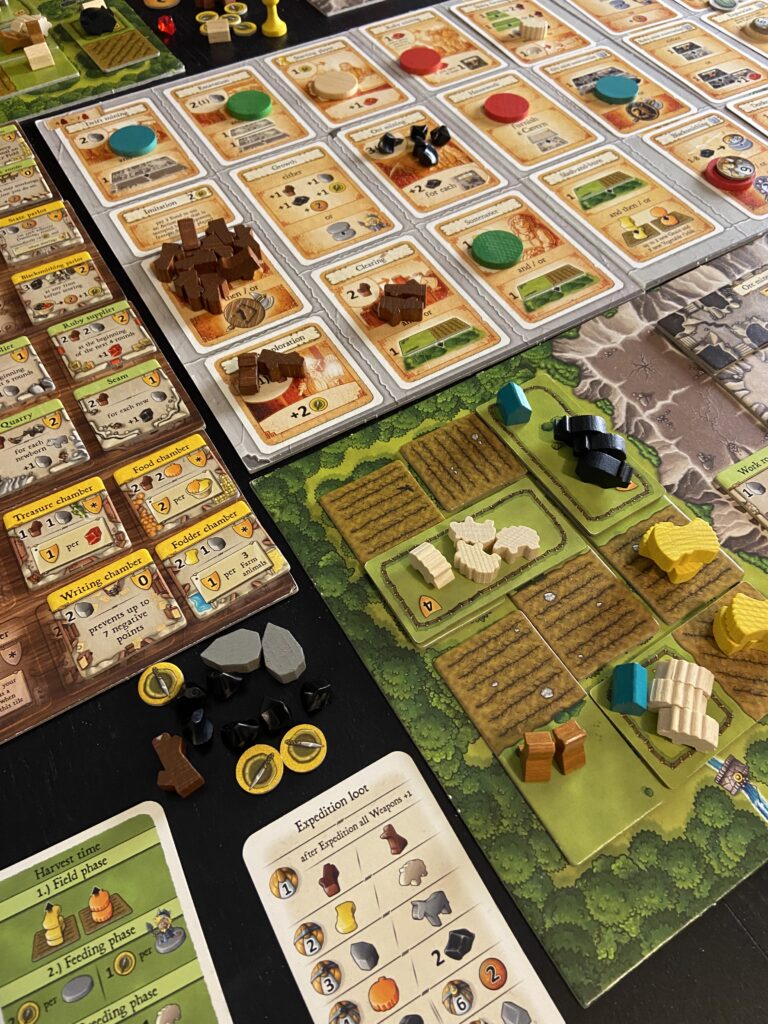
Game: Caverna – The Cave Farmers
Designer: Uwe Rosenberg
Year: 2013
Country: Germany
Publisher: Lookout Games
Caverna is a great example of how the theme affects the gameplay experience. It’s essentially a reimplementation of Agricola, to the degree that the rulebook tells you which sections you can skip if you already know them from the other game.
Agricola is a game of rural scarcity where your farmer family tries to eke out an existence from the hard earth. The vibes are harsh and it feels like food is always in danger of running out. Every time you try to make a play, someone else has already claimed that crucial action space and your children starve.
In contrast, Caverna is built around a fantasy theme of dwarves living in a mountain cave, dividing their time digging deeper into the rock and farming outside. Mechanically, it’s much the same as Agricola, but in terms of vibe it’s very different. No longer grim and lean, Caverna feels pleasant and bounteous even if here too the dwarves may have to go begging if there’s not enough food.
Caverna is a worker placement game where you try to win by accumulating as much gold (meaning victory points) from different sources as possible. You can plant crops, raise livestock, build an ore mine and go on expeditions after you’ve armed your dwarves. If you place your dwarf on an action space, that action cannot be used by another player during the same round.
The competition for possible action spaces is ameliorated by the number of different potential strategies. When you see an opponent going after one type of space, you can choose a different strategy so you won’t have to compete for the options.
The expeditions work so that you use ore to arm your dwarves with weapons of various strengths. There are action spaces on the board allowing one of your dwarves to go on one, two, three or even four expeditions, and bring back loot. What you get depends on how good your weapon is. Each expedition grants experience, increasing the power of your weapon.
In Agricola, you have cards which improve your engine and give bonuses of different types. In Caverna, the cards have been replaced by tiles, rooms which you build into the mountain. Mechanically their function is much the same, but now they’re presented all at once on a big board of options. You can choose to build whichever you like, if you have the resources for it and manage to snatch the necessary action space in time.