This is a series of posts where I play 100 boardgames.
Game: Firefly: The Game
Designer: Aaron Dill, John Kovaleski & Sean Sweigart
Year: 2013
Country: U.S.A.
Publisher: Gale Force Nine
The slogan of Firefly: The Game is: “Find a crew, find a job, keep flying” and it summarizes the experience surprisingly accurately. The board represents the space and planets that make up the tv show’s setting, and each player is a captain trying to make it big with their own Firefly-class vessel. Hauling cargo if you want to keep things legal, or doing criminal and immoral jobs if not. You can buy upgrades, hire crew, and gain jobs which, when fulfilled, pay money.
Whatever the win conditions on the story card you chose to use, the core of the game is in moving around the board, evading the Alliance and the Reavers and transporting things from A to B. Some of the crew members and even captain are moral, in which case they become disgruntled when forced to participate in immoral acts. Disgruntled crew may leave or get poached by another player. Crime pays more than honest work, but it’s also more difficult.
The crew mechanic is interesting, as crew members are comparatively cheap to hire, but you have to pay them a cut from the proceeds of each successful job.
We played the game twice, and the first was clearly a practice run. It got really fun in the second game, when we knew what to expect and also had moved on from the starter scenario and it’s relatively simple goals. The vibe of the tv series is very strong, and it’s fun to fly around its setting. The game generated appropriate story events at a steady pace and it felt like you were inhabiting this world.
Star Wars: Outer Rim is built on the same core design as this game, and the changes it made to the formula seemed to reflect my experience playing Firefly: The Game. Outer Rim has more interaction between players and a smaller board in which its easier to run into each other. Yet Firefly: The Game had a breezy simplicity to it that Outer Rim seemed to have lost, at least to some degree. This is a common issue when improving on a successful formula: The design gets better, but the game experience itself may also lose something in the process.
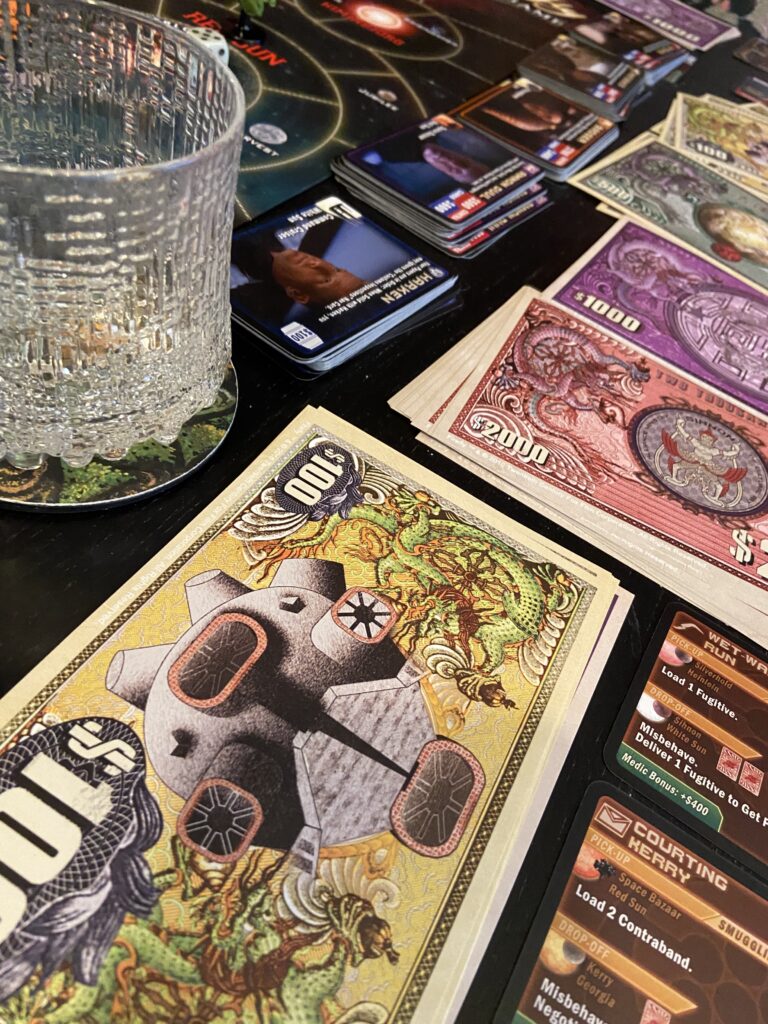
We played the game using the Big Money expansion. It replaces the small paper banknotes with oversize versions that take a lot of space on the table. They don’t have any impact on gameplay, but in a way I can’t fully articulate they nevertheless improved the experience significantly. It was simply fun to have big money instead of small money.